We analyzed the top prop trading firms in 2026 based on payout reliability, evaluation rules, and real trader feedback. This guide breaks down FTMO, Topstep, The5ers, and FundedNext so you can choose the right firm with confidence.
class SampleComponent extends React.Component {
  // using the experimental public class field syntax below. We can also attach
  // the contextType to the current class
  static contextType = ColorContext;
  render() {
    return <Button color={this.color} />
  }
}
Last Updated: June 2, 2026
Picking the wrong prop firm costs more than a failed challenge fee. It costs weeks of trading time, mental energy, and sometimes the confidence to try again. The difference between firms that pay and firms that find reasons not to is not obvious from a pricing page. It shows up in the drawdown rules, the payout terms, and what happens when you actually request a withdrawal.
We spent weeks verifying payout records, reading thousands of Trustpilot reviews, and testing each firm's rules against real trading scenarios. Out of the dozens of prop firms operating in 2026, four stood out with the strongest combination of payout history, fair evaluation rules, and long-term track record. This guide breaks each one down from the inside: how the evaluation works, what the costs actually add up to, where traders get tripped up, and who each firm is built for.
If you want a broader comparison of more firms with side-by-side tables and scoring, check out our full 10-prop firm rankings. This guide goes deeper so you can choose with confidence.
What Is Prop Trading and How Does It Work
Proprietary trading firms give you access to their capital in exchange for a share of the profits. You do not deposit your own money into a trading account. Instead, you pay a one-time challenge fee or monthly subscription, pass an evaluation that tests your risk management and profitability, and then trade a funded account.
Once funded, your profits and losses are tracked and you receive real payouts based on your performance. Some firms route orders through regulated brokers with real market spreads. The business model works because firms collect challenge fees from all participants, while only a percentage of traders pass and reach the payout stage.
Most firms use a similar structure. You trade a challenge account with specific rules: a profit target you need to hit, a maximum daily loss you cannot exceed, and a maximum overall drawdown. Hit the target without breaking the rules and you get a funded account. On the funded side, there is no profit target. You just trade within the risk limits and request payouts on a set schedule.
The firm keeps a percentage of your profits, typically 10 to 20 percent. You keep the rest. Some firms start you at 80 percent and scale to 90 or even 100 percent as you prove consistency.
How to Choose a Prop Firm That Fits Your Trading
The right prop firm depends on three things: what market you trade, how much risk you take per trade, and how much you can afford to spend on challenge fees. Every other feature, including profit splits, scaling plans, and platform options, is secondary to those three.
Match the Market
If you trade CME futures like ES, NQ, or CL, your options are limited to futures-specific firms like Topstep. If you trade forex, indices, or commodities on CFDs, you have more choices including FTMO, The5ers, and FundedNext. Some firms offer both, but most specialize.
Check Your Numbers Against the Rules
Every firm has a maximum daily loss and a maximum overall drawdown. If your trading style regularly has 3 to 4 percent drawdown days, a firm with a 5 percent daily limit gives you almost no room for error. You need to know your worst drawdown over the last 3 months, your average risk per trade, and your win rate across at least 50 to 100 trades before choosing a firm.
Calculate the Real Cost
A $500 challenge fee is not the real cost. The real cost is $500 multiplied by however many attempts it takes you to pass. If you pass on your first try, great. If it takes three attempts, that is $1,500. Firms with monthly subscriptions like Topstep cost less upfront but add up over time. One-time fee firms like FTMO cost more per attempt but have no recurring charges.
Verify Payout History
Check Trustpilot reviews specifically for payout complaints. One or two negative reviews mean nothing. Dozens of traders reporting delayed or denied payouts is a pattern. The four firms in this guide all have years of payout history and thousands of reviews confirming they actually pay.
The 4 Best Prop Firms in 2026
We selected these four firms based on payout track record, evaluation fairness, rule transparency, and how long they have been operating. All data is based on publicly available information as of March 2026
Firm
Split
Max Capital
Best For
Trustpilot
Platform
FTMO
80–90%
$2M scaled
Overall reliability
~4.8
MT4 / MT5 / cTrader
Topstep
90%
$750K
Futures trading
~3.4
TopstepX
The5ers
50–100%
$4M scaled
Long-term scaling
~4.8
MT5 / cTrader
FundedNext
80–95%
$4M scaled
Eval profit share
~4.6
MT4 / MT5 / cTrader
FTMO
FTMO has been paying traders since 2015. Ten years of operation with no major payout scandals, no sudden rule changes on existing accounts, and no periods where traders could not withdraw. That is rare in an industry where firms disappear overnight. Their Trustpilot sits at approximately 4.8 stars across thousands of verified reviews.
The evaluation is two steps. In Step 1, you need to hit a 10 percent profit target. In Step 2, the target drops to 5 percent. Both steps have a 5 percent maximum daily loss and a 10 percent maximum overall drawdown. The drawdown is static, which means the floor does not move up as your balance grows. This is more forgiving than trailing drawdown models because a winning streak does not tighten your risk limits.
What It Costs
The 100K challenge is priced at approximately €540 at standard rates, though FTMO frequently runs promotions that lower this. Always check the pricing page before purchasing. If you pass both steps and reach the funded stage, FTMO refunds that fee with your first profit split. So if you pass on the first attempt, your net cost is zero. If you fail, you pay again for each retry.
Payout Structure
You start at an 80 percent profit split. Payouts are available on-demand after 14 calendar days from your first trade, and FTMO processes them in an average of about 8 hours. The Scaling Plan raises your split to 90 percent and increases your account balance by 25 percent every four months when you hit 10 percent net profit. Starting allocation is up to $400K, scaling to $2 million.
Where Traders Get Tripped Up
The 5 percent daily loss limit is the main account killer. One bad session where you lose 5 percent of your starting daily balance and your account is gone, even if you are up 8 percent overall.
The two-step process takes longer than single-step alternatives. If you need 30 trading days for Step 1 and 20 for Step 2, that is almost two and a half months before you are funded.
The 80 percent starting split is lower than newer firms offering 85 or 90 percent from day one. You need to scale up to match them.
Who FTMO Is For
Traders who prioritize reliability over everything else. If you want the firm that is most likely to still be around in five years and has never had a payout scandal, FTMO is that firm. It is not the cheapest or the most generous on splits, but it is the safest choice.
Topstep
Topstep launched in 2012, making it the longest-running prop firm in the industry. They focus exclusively on CME futures: ES, NQ, CL, GC, and other CME-listed contracts. They have been paying traders consistently for over 13 years, longer than any other prop firm operating today.
The evaluation is a single-step Trading Combine. You need a minimum of 2 trading days to pass due to the consistency target, which requires that your best day cannot exceed 50 percent of your total profit. There is no maximum time limit. As of February 2026, Topstep offers two paths: the Standard Path and the No Activation Fee Path.
What It Costs
Account
Standard Monthly
Activation Fee
No-Activation Monthly
Max Drawdown
50K
$49/mo
$149
$109/mo
$2,000 (trailing)
100K
$99/mo
$149
$159/mo
$3,000 (trailing)
150K
$149/mo
$149
$209/mo
$4,500 (trailing)
The Standard Path charges a lower monthly fee plus a $149 activation fee when you get funded. The No Activation Fee Path charges more per month but nothing extra at funding. If you expect to pass quickly, the Standard Path costs less overall. If you think it might take a few months, the No Activation Fee Path avoids the upfront hit when funded.
Payout Structure
New traders who joined after January 12, 2026 receive a flat 90/10 profit split from day one. Legacy traders who joined before that date get 100 percent on their first $10,000 in payouts, then 90/10 after that. Many online reviews still reference the old 100 percent structure, so verify the current terms before signing up.
Topstep offers two payout paths: Standard Path requires 5 winning days with at least $150 profit each, and you can withdraw up to 50 percent of your balance per request (up to $5,000). The Consistency Path requires 3 trading days with a 40 percent consistency target, meaning no single day can represent more than 40 percent of your total profit.
Where Traders Get Tripped Up
The trailing drawdown moves up with your highest balance. If your account hits $103,000, your drawdown floor moves to $100,000. You cannot give back early gains without risking your account.
Monthly subscriptions add up. If you need three months to pass the 100K Combine on the Standard Path, you have spent $297 plus the $149 activation, totaling $446 before earning anything.
Futures only. No forex, no crypto, no stocks. If you trade anything outside of CME-listed contracts, Topstep is not an option.
Who Topstep Is For
Futures traders who want the longest track record in the industry. If you trade ES, NQ, or CL and want a firm that has survived every market condition since 2012, Topstep has proven it can last. The single-step evaluation with just a 2-day minimum also makes it one of the fastest paths to funding if you are already profitable. You can also run up to 5 accounts simultaneously through copy trading, bringing your total max capital to $750K.
The5ers
The5ers built their model around long-term scaling. Instead of giving you a large account immediately, they start you smaller and double your capital at each milestone. The idea is that traders who prove consistency deserve progressively more capital, and The5ers backs that up with a path from a few thousand dollars all the way to $4 million at 100 percent profit split.
They have funded over 260,000 traders and have over 21,000 Trustpilot reviews at approximately 4.8 stars. Three distinct programs let you choose your entry point and risk level.
The Three Programs
Bootcamp: The cheapest entry at $95 for a $100K evaluation. Three-step process with 6 percent profit targets at each stage. Maximum drawdown is 5 percent. You only pay the remaining fund fee after you pass. Best for traders who want low upfront cost and are willing to go through a longer evaluation.
High Stakes: Two-step evaluation. Step 1 target is 8 percent, Step 2 is 5 percent. Maximum drawdown is 10 percent overall. Profit split starts at 80 percent and scales to 100 percent. The 100K High Stakes challenge costs approximately $530. Best for experienced traders who want higher starting capital and faster funding.
HyperGrowth: Single-step with a 10 percent target and 6 percent max drawdown. Profit split starts at 50 percent but scales quickly. Every time you hit a profit target, your capital doubles. Best for traders who are confident in fast growth and willing to accept a lower starting split.
Payout Structure
Splits range from 50 percent on HyperGrowth to 80 percent on High Stakes at the starting level. All three programs scale to 100 percent profit split at the highest tier. Scaling happens when you hit profit milestones, and your capital doubles at each one. There are no time limits on any evaluation.
Where Traders Get Tripped Up
HyperGrowth starts at 50 percent split. That is significantly below the industry average. You are giving up half your profits until you scale up, which takes consistent monthly performance.
Scaling takes time. Doubling your capital sounds great, but hitting profit targets over multiple months requires sustained consistency. Traders who are inconsistent month to month will stall at lower tiers.
The Bootcamp is three steps. More stages means more chances to fail. Each step has a 6 percent target and a 5 percent drawdown limit, so you need to be precise three times in a row.
Who The5ers Is For
Traders who think in terms of years, not weeks. If your goal is to build a real trading career with progressively larger capital and you do not mind starting smaller to get there, The5ers gives you the clearest path to $4 million at 100 percent split. The no-time-limit evaluations also make this a good fit for swing traders who do not want daily pressure.
FundedNext
FundedNext introduced a feature no other major firm offers: you earn 15 percent of your profits during the evaluation phase, even if you fail the challenge. That changes the economics of prop trading. If you generate $8,000 in profit during a challenge and do not hit the full target, you still collect $1,200. That can offset your challenge fee or fund your next attempt.
Founded in March 2022, FundedNext has paid out over $261 million to more than 93,000 traders. Their Trustpilot rating sits at approximately 4.6 stars across 42,000 reviews. The firm is newer than FTMO or Topstep, but the payout volume and review count show rapid growth.
What It Costs
The Stellar 100K challenge costs $549.99. FundedNext offers both one-step and two-step evaluations under the Stellar model. Prices for smaller accounts start as low as $32. The evaluation fee is not refunded, but the 15 percent profit share during the challenge phase offsets the cost in a way other firms cannot match.
Payout Structure
Funded accounts start at 80 percent profit split. The Lifetime Payout Add-On pushes the split to 95 percent. Accounts scale up to $4 million through consistent performance. Drawdown rules vary by challenge type. The Stellar 2-Step uses 5 percent daily and 10 percent max. The Stellar 1-Step is tighter at 3 percent daily and 6 percent max. Stellar Lite sits in between at 4 percent daily and 8 percent max. There is no time limit on Stellar challenges.
The News Trading Rule
This is the one rule every FundedNext trader needs to understand. On funded Stellar accounts, trades executed within 5 minutes before or after a listed high-impact news event are subject to a 40 percent news profit split. That means only 40 percent of profits from those trades count toward your balance. Losses during news events, however, count in full. If you are a news trader, this rule significantly impacts your strategy.
Where Traders Get Tripped Up
The news profit split rule catches traders who are not aware of it. If you enter a position 4 minutes before NFP and make $2,000, only $800 counts. But if you lose $2,000, the full loss applies.
The firm is younger. Three years of operation means FundedNext has not been tested through a prolonged bear market or a major industry shakeup. The payout numbers are strong, but longevity is still being proven.
Challenge fees are not refunded. Unlike FTMO, which refunds your fee with your first payout, FundedNext keeps the fee. The 15 percent evaluation profit share is the offset, but you need to actually generate profit during the challenge to benefit from it.
Who FundedNext Is For
Traders who fail challenges frequently. The 15 percent evaluation profit share means your losing attempts are not total losses. If you are the type of trader who gets close to the target but does not always cross it, FundedNext gives you something back for your effort. It is also a strong choice for traders who want to scale to large accounts, with a $4 million ceiling and a path to 95 percent split.
What Should You Check Before Paying for a Prop Firm Challenge?
The biggest mistake traders make is choosing a prop firm before understanding their own performance. If you do not know your win rate, average drawdown, and best setups, you are guessing at whether a firm's rules fit your trading. Guessing costs money.
Before spending anything on a challenge fee, you should know your win rate across at least 50 to 100 trades, your average risk-to-reward ratio, your worst drawdown over the last 3 months, and which sessions and setups generate most of your profit. Without these numbers, you cannot match yourself to a firm.
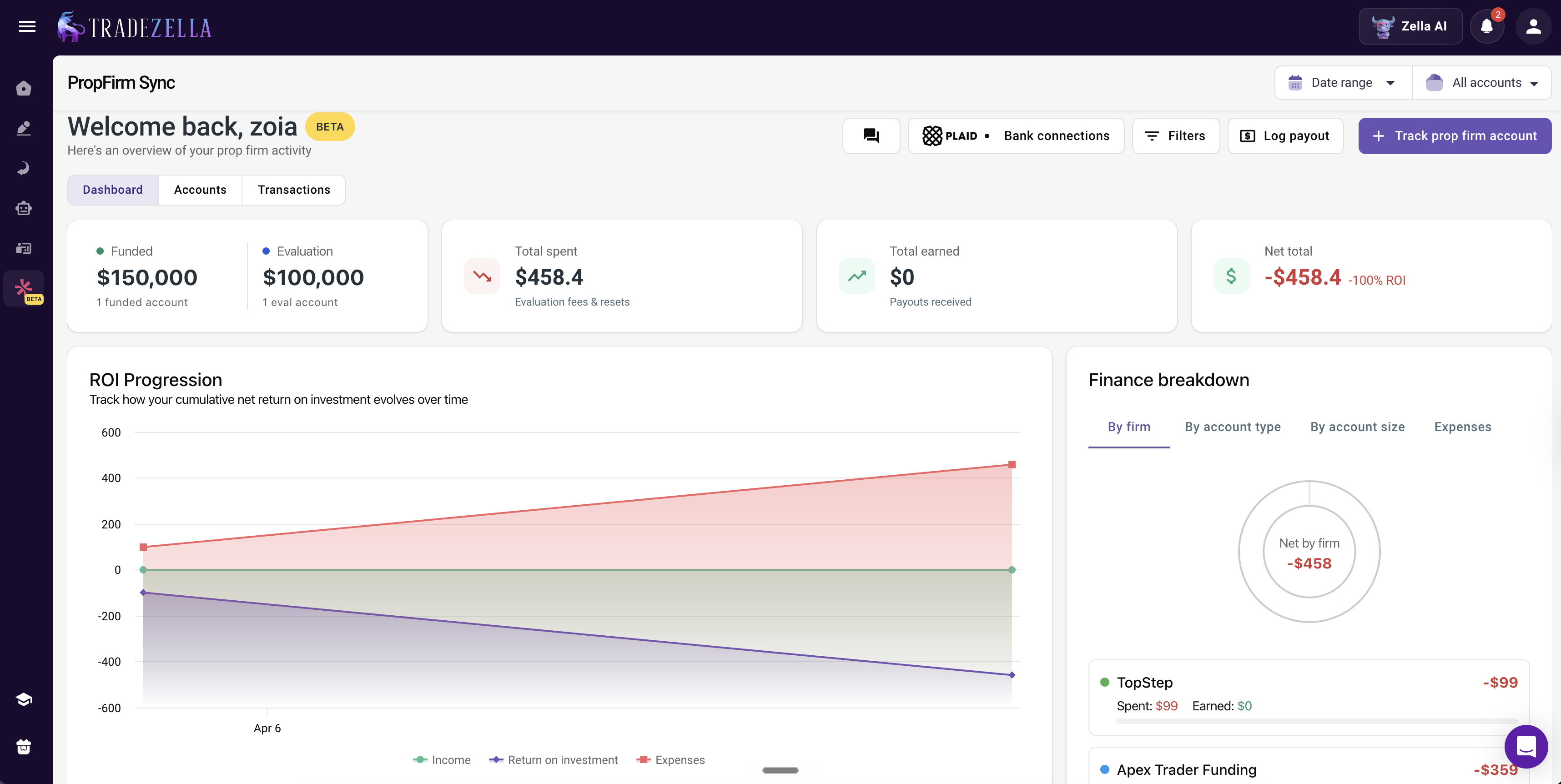
TradeZella is a trading journal that tracks this automatically. Connect your broker or prop firm account and your trade data syncs in. Then use Prop Firm Sync to link your trading accounts to each evaluation, so you can track challenge progress, daily drawdown limits, and payout milestones from one place. Filter your analytics by Strategy, time of day, or session to find exactly where your edge is and where you are bleeding money.
Zella AI adds a layer most traders skip. The Market Sentiment Briefing agent builds a personalized pre-market plan based on how you trade, your assets, and what setups you look for. After the session, the Session Review agent checks whether you actually followed that plan and journals the entire day automatically. Every trade gets tagged by the Auto Trade Tagger based on rules you set, so your data is always organized and ready to analyze. The result is that after a few weeks of trading, Zella AI knows your style well enough to show you which firm's rules match your actual numbers, not the numbers you hope for.
You can also use the free TradeZella Prop Firm Calculator to compare challenge costs, profit splits, and what you would actually take home at different firms.
What Are the Biggest Mistakes When Choosing a Prop Firm?
1. Chasing the Highest Profit Split
A 95 percent split means nothing if the firm has a history of denying payouts or changing rules after you are funded. A firm paying 80 percent reliably for ten years is worth more than a firm promising 95 percent that launched last year. Always weight payout reliability above split percentage.
2. Ignoring Drawdown Type
Static drawdown and trailing drawdown are fundamentally different. With static drawdown, your floor stays fixed. With trailing drawdown, the floor rises with your highest balance. A trader who makes $3,000 and then gives back $2,000 might be fine under static rules but could lose their account under trailing rules. Know which type your firm uses before you start.
3. Not Calculating Total Cost
Challenge fees are not the only cost. Add up the fee times the average number of attempts, any monthly subscriptions, activation fees, platform fees, and data fees. Some traders spend $2,000 or more before getting funded because they underestimate how many attempts it takes.
4. Choosing a Firm Before Tracking Performance
If you have never journaled your trades, you do not know your real numbers. Most traders overestimate their win rate and underestimate their drawdown. Track at least 50 to 100 trades with real data before paying for a challenge. A tool like TradeZella gives you objective data instead of gut feelings.
5. Trusting Marketing Over Reviews
Every prop firm's website says they have the best splits, fastest payouts, and happiest traders. Look at Trustpilot, Reddit, and Discord instead. Search for the firm's name plus the word 'payout' and read what actual traders are saying. One bad review is noise. Twenty similar complaints are a pattern.
Which Firm Should You Choose
If you want maximum reliability: FTMO. Ten years, no scandals, fee refunded on first payout.
If you trade futures: Topstep. Longest-running futures prop firm, $1.1 billion in payouts, single-step evaluation.
If you want to scale to $4M: The5ers. Clear milestone-based scaling to $4 million at 100 percent split, no time limits.
If you want to earn during evaluation: FundedNext. 15 percent profit share on challenge attempts, even failed ones.
If you are on a tight budget: The5ers Bootcamp at $95, or Topstep 50K at $49/month.
If you are a swing trader: The5ers or FTMO. No minimum trading day requirements on The5ers. FTMO has no time pressure on Step 1 or Step 2.
Frequently Asked Questions
What is the best prop firm in 2026?
It depends on your market and trading style. FTMO is the most reliable for forex and CFD traders. Topstep is the strongest choice for CME futures. The5ers offers the highest scaling potential. FundedNext gives you the best economics if you fail challenges frequently.
Do prop firms actually pay traders?
The four firms in this guide have collectively paid out over $1.5 billion. FTMO has paid since 2015, Topstep since 2012, The5ers since 2016, and FundedNext has distributed over $261 million since 2022. However, not all prop firms are reliable. MyFundedFX shut down in February 2026 with little warning. Always check recent Trustpilot reviews and payout proof before buying a challenge.
How much does a prop firm challenge cost?
For a 100K account: FTMO is approximately €540 at standard rates (promotions may lower this), The5ers Bootcamp starts at $95, The5ers High Stakes is around $530, and FundedNext Stellar is $549.99. Topstep uses a monthly subscription at $99 per month for 100K plus a $149 activation fee when funded. Always verify current pricing on each firm's website before purchasing.
What is the difference between static and trailing drawdown?
Static drawdown sets a fixed floor. If your $100,000 account has a 10 percent max drawdown, your floor is $90,000 regardless of how high your balance goes. Trailing drawdown moves the floor up with your highest balance. If your account hits $105,000, your new floor becomes $95,000. FTMO uses static drawdown. Topstep uses trailing drawdown.
Should I track my trades before joining a prop firm?
Yes. Knowing your win rate, average drawdown, and best setups lets you choose a firm whose rules match your trading style. A trading journal like TradeZella connects to your account and gives you this data automatically. You can also use the free TradeZella Prop Firm Calculator to compare what you would actually take home at different firms.